About the creator
A handle, a late-night stream and a pivot from building one big app to building in public.
The short version
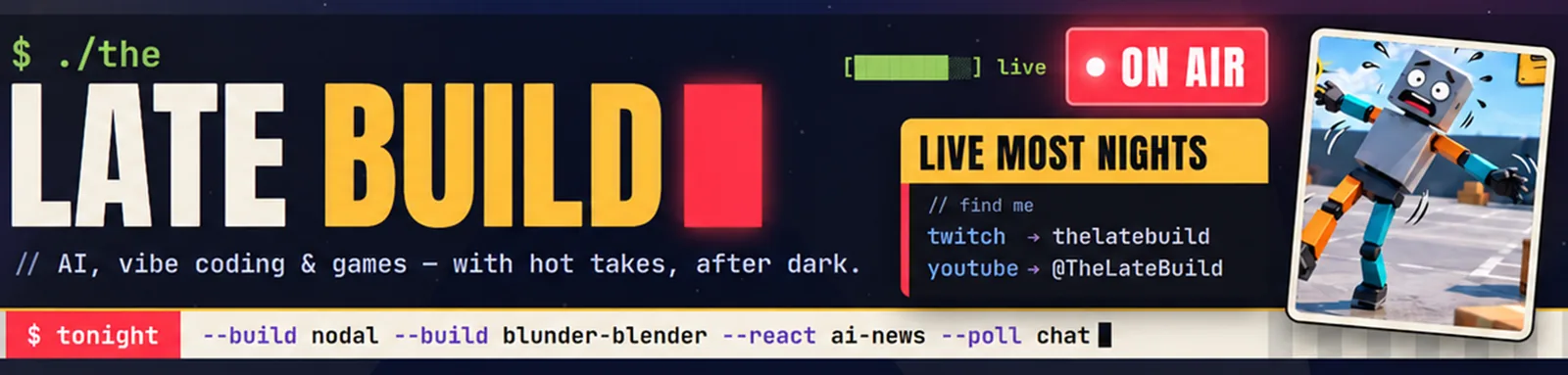
vAlentino718 is the handle behind The Late Build, a channel and creator hub that turns AI-assisted software development into a public, repeatable show. The creator is a self-described newcomer to vibe coding who decided in July 2026 to “turn on the camera and record the entire process of learning,” and has livestreamed building ever since. This site keeps the handle only: no real name, no personal details, just the work and the links.
The pivot: from one big product to many small bets
The first livestream, on July 27, 2026, was titled “Building an App With AI: ToolTabs.” ToolTabs was a Windows productivity app: a tabbed home for terminals and AI coding agents. Over the following weeks it went through a rename and a second version, and eventually became Nodal, an agent workspace with an Agent Mode, a Tab Mode and a Notification Center. You can read that product story on the Nodal history page. The version that matters here is the lesson drawn from it.
By mid-August the creator had stepped away from the stream for about ten days, feeling like things were being built “without really knowing where I was going,” and returned for Day 15 with a clearer idea of what the app should be. On Day 20 the stream announced a new workflow: stop starting ten projects at once, choose one real project and follow a plan all the way through. Nodal shipped as a public preview on October 1, 2026. And then came the second realization. Shipping an app is no longer the hard part of the vibe-coding era. A capable agent can produce a convincing first version of almost any idea quickly, which makes ideas cheap and distribution expensive. The Nodal site makes the same point in its own history section.
The Late Build is the response: earn online with the skills that are already working, which means generating videos, making reaction videos with an AI avatar host, and livestreaming the whole process so other people can learn from it. The projects on this site are the byproducts and the experiments: a stream control panel, a game platform, games, benchmarks, data tools and a new channel concept.
Timeline
| Date (2026) | What happened |
|---|---|
| Jul 27 | First vibe-coding livestream: building ToolTabs with AI agents. |
| Aug 3 | Day 5: first playable test build of a game, plus more ToolTabs features. |
| Aug 12 | Day 15: back after a ten-day break with a clearer idea of what the app should be, including a notification center for AI sessions. |
| Aug 17 | Day 20: a new “choose one real project” workflow. |
| Sep 23 | Letting AI set up the whole livestream (OBS scenes, overlays, chat bots, dashboard) in a long test of Claude Opus 5.5. The dashboard that became BroadcastHQ is born in this session. |
| Sep 25–29 | Model-versus-model streams (Opus 5.5 against GPT-6 and GPT-6.1) and the first reveal of Blunder Blender. See benchmarks. |
| Oct 1–3 | Nodal Preview release streams and the first public beta. |
| Oct 5–6 | Nodal Play v0.1 goes live, and Nodal Strike becomes its first game. |
| Oct 8–9 | A fresh start: Day 1 of a new series, two TikTok accounts launched, avatar reaction shorts begin. |
| Oct 10–11 | First public dual stream to YouTube (horizontal and vertical) and Twitch. More shorts. |
What gets made here
Live shows
Most nights the creator goes live and works through a to-do list on camera: coding with Claude and Codex agents, reacting to videos, picking tasks with chat polls and answering questions about workflow. The livestream page explains the format, and the socials page lists the recordings.
Software and games
The software side is a mix of products and playgrounds. Nodal Play is a hosting and room system for games streamers can play with their audience. Nodal Strike is the first game on it and a template for building others. Blunder Blender is a physics-heavy robot game that is still mostly ahead of it. The web projects (Game of Life twice, Celebrity Explorer) show what one agent session can produce when the prompt is clear.
Videos
The video side is an experiment in making short reaction videos at low cost: an AI avatar host speaking over a clip, a branded footer, captions and music, assembled with a mix of local tools and agents. Read the full pipeline on the avatar shorts page. A planned explainer channel, Theatre of War, would use the same production habits for conflict news with sourced footage and 3D map sequences.
How the work gets done
Almost everything here is built by AI agents under human direction. Claude Code and Codex agents write and review code, sub-agents handle bounded jobs in parallel, and the human decides what to build, tests it, and says yes or no to anything public. That is a deliberate division of labor, and it is documented in detail in The vibe-coding workflow. Two principles recur everywhere on the stream: confirm before anything is published, and write down what changed so the next agent session (or the next human) can pick up the thread.
The same tools are tested openly. The benchmarks page covers two small tests, a low-poly spaceship and a low-poly island, run against several models with the same prompt. Those results are anecdotes with real numbers behind them, not leaderboards.
Principles
- Show the rough parts. Failed experiments, stream drops and wrong turns are part of the record. The livestream page lists a few.
- Say what is unfinished. Theatre of War is an idea. Blunder Blender is a prototype with a lot of work left. Nodal Play is at version 0.1. Each page states its real status.
- Keep personal details out. The channel is run under a handle. Chat messages shown on this site are made up for illustration, and real viewers are not named.
- Credit the sources. Reaction clips are credited in video descriptions, music is attributed, and open datasets (such as the Life pattern catalogue) are named.
- Be honest about money. Stream titles carry an “Earned” counter. As of October 12, 2026 it reads $0.00, and the channel has under 200 subscribers.
Contact and community
The best place to ask a question or report a bug is the Discord, or chat during a stream on Twitch or YouTube. Public posts go to X. The full list of accounts is on the socials page. A tip link exists for people who want to support the stream: it is listed there too, and it is entirely optional.
New here? Start with the livestream page if you want to learn by watching, the games index if you want to play, or the FAQ for quick answers.