Blunder Blender
A clumsy-robot warehouse game that is more about falling over gracefully than winning. Prototype today, chaos multiplayer later.
The idea: a robot that is bad at its job
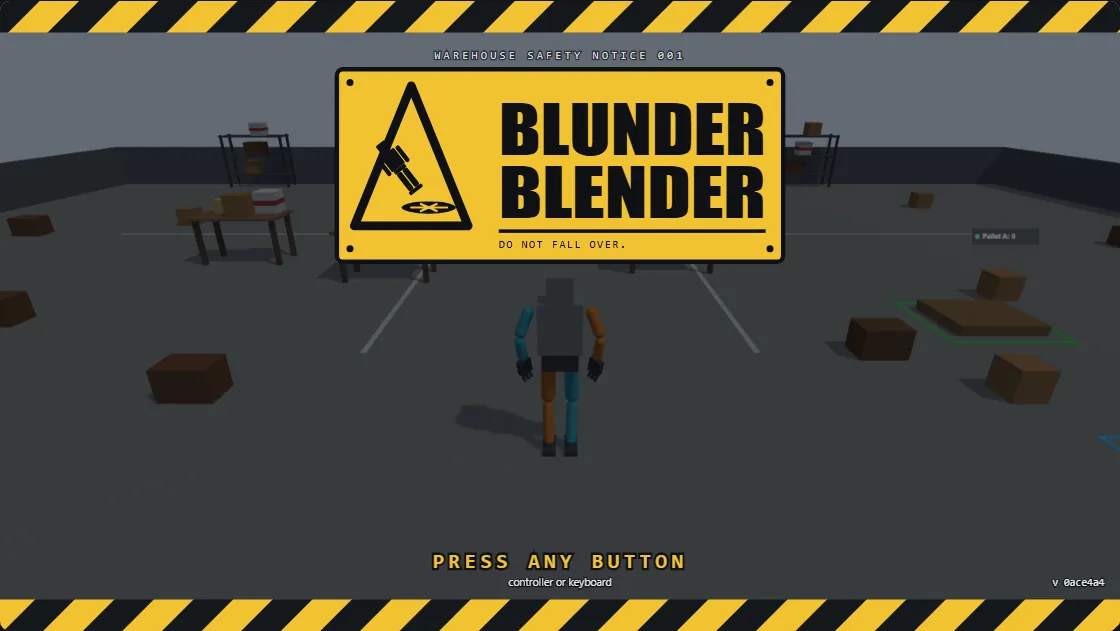
Blunder Blender is a physics game about a clumsy humanoid robot working in a warehouse built for humans. The player does not press a button to “walk.” Instead, the two analog sticks control the robot’s limbs, and the robot is a jointed physics body that has to balance, step, reach for boxes, pick them up, carry them and put them down. It falls over a lot. That is the point: the first prototype was designed to answer one question, is controlling a robot’s arms and legs with two sticks fun? Visuals were intentionally secondary, so the first versions used plain shapes.
The game was first revealed on stream on September 27, 2026, in the Day 23 broadcast, and has been a recurring subject since. It is built in the browser with three.js for rendering and the Rapier physics engine, with Vite as the build tool. The source repository is private, and the public build currently shows an “under construction” title screen by default; the owner opens or closes it deliberately. A single-player copy is also listed in the Nodal Play library with a beta tag.
How it plays
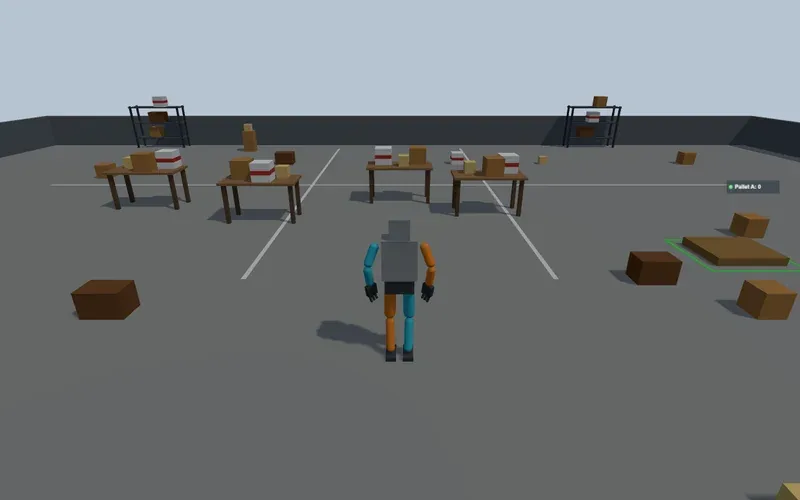
The world is a graybox warehouse with work tables, shelves, a pallet area and boxes of three sizes. The robot’s balance assist starts at about 60 percent and can be changed live, and it gives up when the robot is badly off balance, which means you can actually fall. After a fall you press a button to get up; an auto get-up option exists for people who would rather not. A small delivery mini-game adds a goal: three drop zones (two pallets and a bin) with a live Delivered counter and a best score.
Five control profiles
Because nobody knew which mapping would feel right, the prototype ships several switchable profiles so they can be compared in one play session. The default came from the creator’s own idea.
| Profile | Idea |
|---|---|
| A: Cross-Gait (default) | Each stick drives one leg and the opposite arm, like a real walking gait. Twisting the sticks sideways turns the hips. Holding a shoulder button switches to hands mode, and the triggers grip. |
| B: Trigger Legs | The sticks move the hands. Hold a trigger to lift a leg and move it with the stick, and the bumpers grip. |
| C: Stick Legs | The sticks place the feet, and pushing outward turns the robot. |
| D: Debug Walk | A forgiving mode: the left stick walks camera-relative, the right stick moves both hands. Useful for testing grabbing without fighting balance. |
| E: Ground Recovery | A joke mode for getting up: the sticks aim the arms, the stick clicks punch, the triggers tuck the legs, and one button deliberately falls over. |
Controllers are read through the browser Gamepad API with radial dead zones and a response curve, and every button has a keyboard equivalent. An Xbox-style controller works directly, and a second controller type works when switched to its Xbox-compatible mode. A separate controller test page checks the mapping before you play.
The tuning panel
Pressing Escape opens a tuning panel with folders for Balance, Arms and grip, Legs and walking, Input, World, Grab and carry, Camera and Experiments. Presets can be saved by name, and the last one loads automatically. The working agreement on the project is that every new tunable value goes into this panel, and every change report says which setting does what. New trial ideas go into the Experiments folder as on-off switches, for example a “smooth robot motion” option that cuts carry wobble by about 45 percent but lets hands catch under table edges. That discipline keeps a chaotic design from turning into a mystery.
Grabbing and carrying
Grabbing has a five-centimeter reach. Two hands carry a box between them, with the hands sliding flat along the sides. With one hand, the box slides after a short delay to a corner hold: visually it hangs at the box’s outer bottom corner, with no weight added to the balance, up to six kilograms. Held boxes do not collide with the robot or with another held box. Three animated fingers per hand show open, fist, flat and cup shapes. The camera has tap-to-change distance, eight angles and three heights, and goes calm while the robot is down.
What was hard
The project notes record lessons that apply to any physics-character game. The Rapier JavaScript API had no spherical-joint motors, so per-axis motors are configured through the raw API, and the axes couple at large angles, which causes circling limbs unless joint targets stay small. Generic joint motors did nothing in the versions tried, so the balance assist uses explicit stable-PD forces solved against realistic inertia, because explicit torques on light bodies explode. Acceleration-based motors scale with the bodies they join, so the knees could not carry the body until all joints moved to force-based motors. Joint frames cannot be changed after creation, so grips use a carry spring rather than rigid joints. Kinematic bodies have infinite force, so the get-up turns off robot-box collisions until nothing overlaps.
The process lessons are just as useful. Do not edit code by slicing between two markers with a script (it once deleted two functions and caused a crash). Run the test suite and a fuzz script before every deploy, and gate the deploy on the result rather than on a pipe. Agents working on the game answer in a simplified technical English style so replies stay short and unambiguous, and every change report ends with the live version hash so the owner knows which build they are looking at.
Where it is going
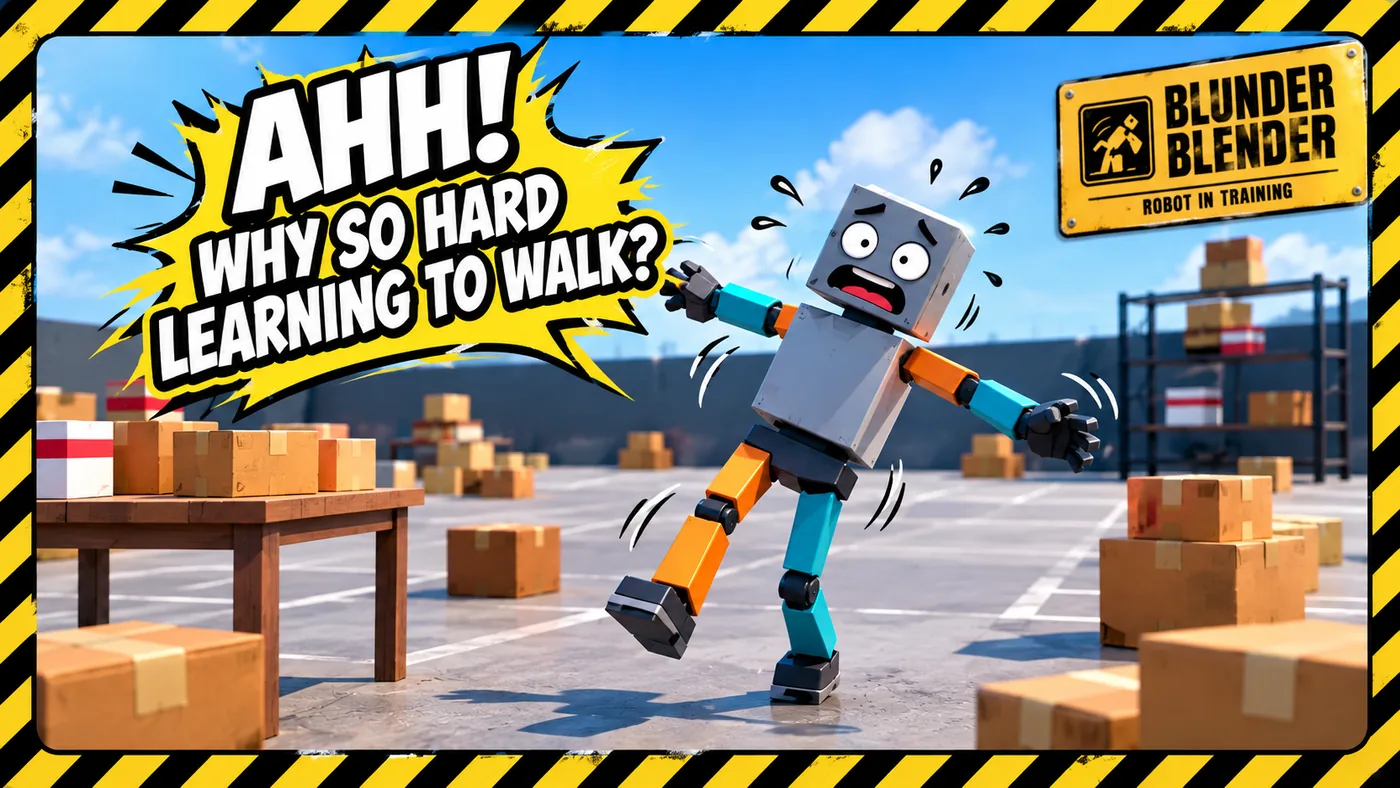
The stated direction is that Blunder Blender grows from a single-player physics toy into a chaotic multiplayer game, and the platform for that already exists in the form of Nodal Play. There is a lot of work left. The honest list: the frame rate on real hardware was never measured in the early handoff (headless tests ran at about ten frames per second in software rendering), control preferences are still being compared, and the multiplayer design has not been built. The original prototype spec listed multiplayer, orders and scoring, forklifts, upgrades, menus, sound and art as out of scope for the first milestone. A delivery mini-game has since appeared, but multiplayer, upgrades and a full art and sound pass are still open. Promotional artwork made with image generation exists, and the Day 23 thumbnail shows the robot mid-stumble.
You can follow its progress on the livestream, where it appears regularly in the day’s to-do list, in the games index, or in the Discord. The Day 23 recording, I Revealed My New AI-Built Robot Game, is the first on-stream look.