Projects
The tools and web apps built around the stream, each with its status and what is still unfinished.
What counts as a project here
Alongside the games, The Late Build produces a small pile of software, almost all of it built with AI agents and almost all of it built because something on the stream needed it. A stream needs a control panel, so there is BroadcastHQ. Coding with several agents at once needs usage visibility, so there is AgentDashboard. Two web apps, Game of Life (once with ChatGPT and once with Claude), came out of side-by-side tests of how each assistant builds a polished single-page simulator. Celebrity Explorer is a research and comparison tool. Larger experiments, such as the AI benchmarks and the planned Theatre of War channel, have their own pages.
This index gives the one-paragraph version of each and an honest status. Every project page ends with what is unfinished.
The projects
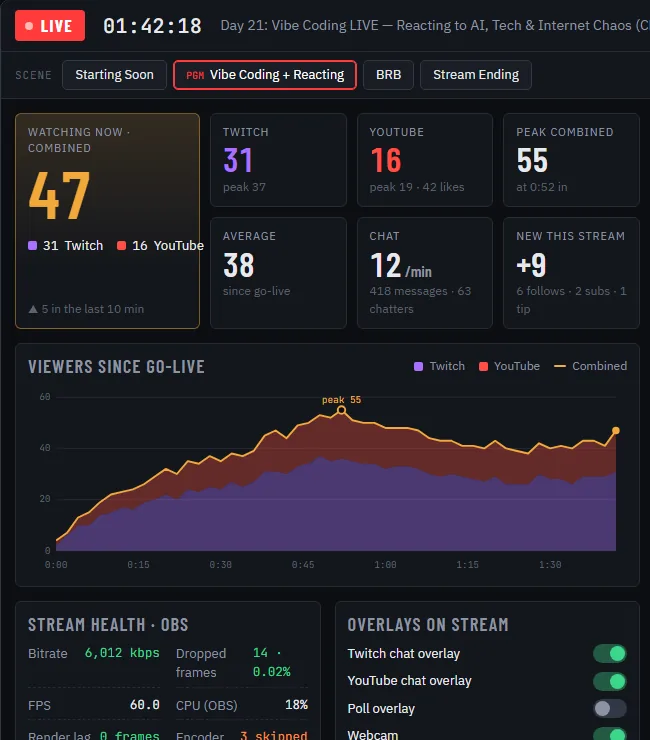
BroadcastHQ
The second-monitor control panel that runs the stream.

AgentDashboard
Usage meters for coding agents in a browser, a terminal and a Claude desktop mod.
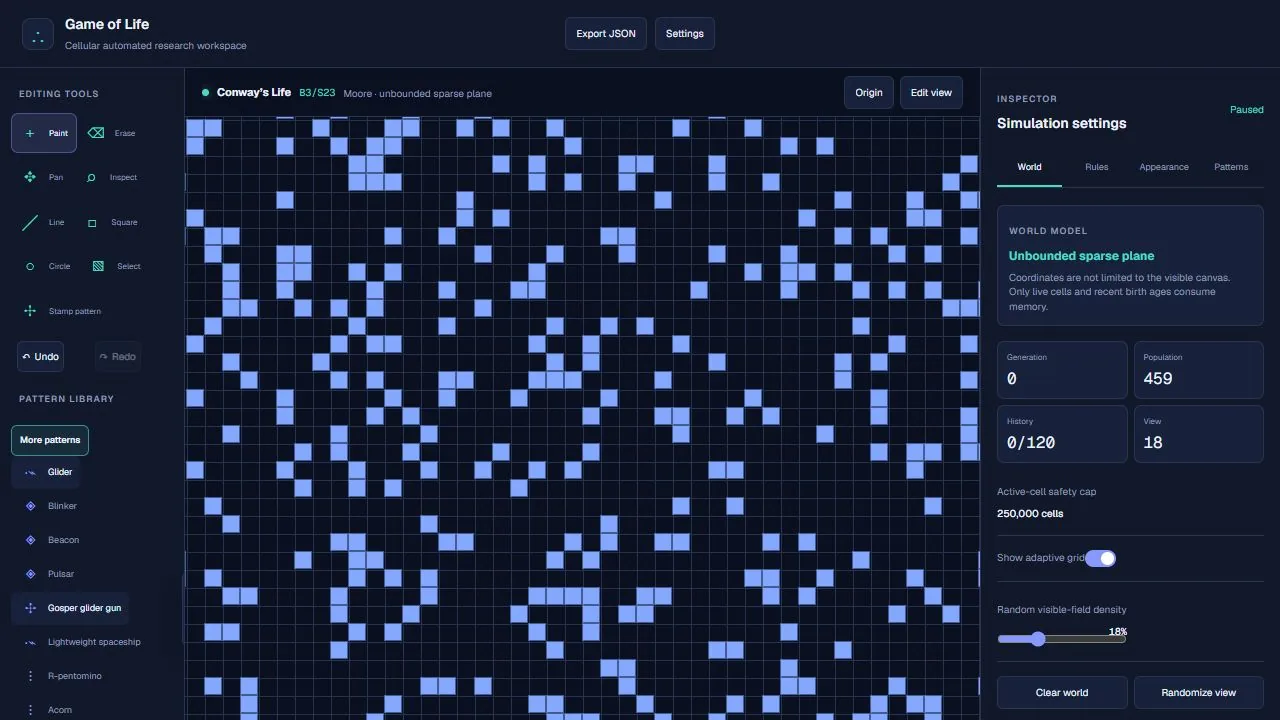
Game of Life
Two complete simulators, one from each assistant, compared.

Celebrity Explorer
Search, filter and chart 1,042 public figures. A research aid with caveats.
| Project | What it is | Built with | Status |
|---|---|---|---|
| BroadcastHQ | Stream control panel | Electron, Node, OBS WebSocket | In daily use on stream |
| AgentDashboard | Agent usage meters and CI status | Node, terminal UI, a browser page, a desktop mod | Three front ends, still evolving |
| Game of Life (Claude) | Standalone simulator and essay | One HTML file, no dependencies | Complete |
| Game of Life (ChatGPT) | Simulation workspace | React, a hosted full-stack starter | Complete, hosted |
| Celebrity Explorer | Comparison and charting tool | Plain HTML, JavaScript, Chart.js | Working; data is approximate |
What they have in common
Written for a reader, not just a runtime
Most of these projects have unusually thorough documentation, and that is not an accident. When agents do the building, the README is the only memory a new session has. The Claude Game of Life README includes a numbered list of bugs already found and fixed, with the instruction to read it before editing. BroadcastHQ keeps a runbook that agents update with every meaningful change. Nodal Strike’s netcode document lists its own known weaknesses. If a project would be hard to hand to a stranger, it would be hard to hand to the next agent session too.
Verified, not just generated
Each project has some kind of check that does not rely on the model’s word. The Game of Life engine is compared against a naive reference implementation by a test suite of 77 assertions. The lights controller in BroadcastHQ has tests and a real-hardware smoke test. Celebrity Explorer has a verification script for its data structure. This habit matters more than any prompt trick, and it is covered in The vibe-coding workflow.
Built on stream
All of this work appears on the livestream. Where a project began as a single prompt, the stream shows the prompt, the first output and the corrections. The social posts list on the socials page shows which sessions touched which projects.
How to read a project page
Each project page follows the same outline so you can compare them. It starts with what the project is and why it exists, then describes how it works at a level a curious non-specialist can follow, then lists the checks that were run, and finishes with limitations and next steps. Numbers are included only when they appear in the project’s own notes or tests, and they carry their context: a measurement on localhost is not a measurement on the internet, and a test count is a snapshot. If a page says a feature is planned, it is not built. If a page says it is verified, there is a test, a measurement or a visual check behind it, and the page says which.
The projects also differ in audience. BroadcastHQ and AgentDashboard are tools for the builder, and they are documented for anyone setting up something similar. The Game of Life apps and Celebrity Explorer are for general visitors, and they double as comparisons of how assistants build things. The pages are intentionally long because the details are the useful part.
Related: Nodal
Several of these projects were built with Nodal, the agent workspace that came first, and one of them (AgentDashboard) is a close sibling of Nodal’s AgentBoard idea. The Nodal product site describes the app itself: its Agent Mode, Tab Mode and Notification Center, plus AgentBoard. This site covers what was built around it.
Not on this page
Games have their own section: games index. Short videos have avatar shorts. The two AI model tests are on the benchmarks page. If you are looking for something that is not mentioned anywhere on this site, it is probably private or unfinished, and the FAQ says how to ask.